
Prototype your idea in HOURS
Learn the 3-step system to validate your startup idea fast, without writing code or wasting time.

🔷 Learn a 3-step system to validate your startup idea without writing code or building a product.
🔷 Master 9 no-code prototyping techniques to test demand in hours, not months.
🔷 Get actionable steps to validate your startup idea before committing serious time or money.
1k+ founders subscribed to this newsletter. Why not you?
I send one practical email a week, no fluff, no motivation quotes, just real founder strategies. Sign up here.
Prototyping = building. That’s something you deeply believe in. Most founders do.
Not a real build, maybe, but at least something substantial. A polished product you could point at to prospects and say, this is it.
That’s what one of my founders thought last year, too.
She was in the sports and athleisure space, and couldn’t figure out how to “prototype” without getting the actual product shipped:
“How can I prototype without actually making anything?”
Up to that point, our work was solid:
We ran deep discovery sessions.
We nailed the customer.
We mapped the opportunity.
Ideas were flowing.
Momentum was good.
And then we hit the prototyping phase.
“We are not going to build anything,” I said.
Instead, we’re going to generate as many ways as possible to test this idea without writing code, manufacturing products, or committing to a direction too early.
Thirty minutes later, we had over 35 different ways to prototype her idea in less than a day.
This is not an exaggeration and we didn’t use any fancy tools.
Just clear thinking.
Most founders believe they need a finished product to test the market.
They don’t.
In fact, building too early is one of the most costly mistakes you can make.
You spend months building. You burn cash. You get emotionally attached. Then you launch and discover something uncomfortable.
NOBODY cares.
For someone who spent a year or more of their lives on this, that realization hurts.
So how do we avoid this?
By testing assumptions.
And by doing it fast.
What do we need to be true?
We don’t realize this, but most of the time, we have deep-seated assumptions about the product we’re building.
Assumptions like:
People want this product
People will pay money for it
People will understand the value intuitively
And many more. These usually go untested until the product gets to market, then (and only then) does the painful truth comes out.
Building too early = high cost, high risk.
Instead, the key to success is to validate before you build.
How? By using fast, no-code prototyping techniques to test assumptions within hours, not months.
And it’s all using the exact three-step process I’ll share with you today.
Step 1: Lay out your assumptions
Write down every assumption behind your solution.
Who it’s for. Why they care. What problem it solves. What they would compare it to. Whether they would pay. How much they would pay.
These are all untested claims.
Then ask yourself a blunt question.
Which of these assumptions, if wrong, would kill the idea?
These are the riskiest assumptions, that we MUST validate first.
How do we identify these? I love this 2x2 matrix, developed by David Bland @ Google Ventures.
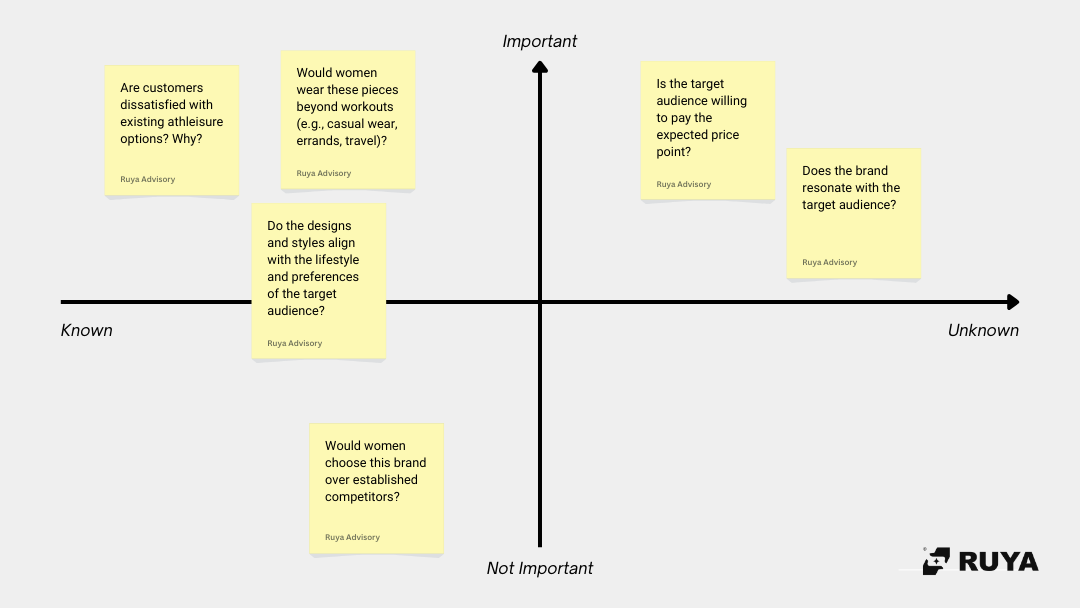
Plot your assumptions:
Important vs. Not Important: Which assumptions would impact your idea most if true / untrue.
Known vs. Unknown: Which assumptions do you feel you already know the answer to vs. ones that are “claims”.
You need to focus on testing the “Important + Unknown” quadrant. This is where risk lives.
DON’T waste time testing things that are safe instead of things that are risky (ex. Features vs demand, UX instead of willingness to pay).
Test deal breakers. In your early days, that’s the only thing that matters.
In the example of the athletics founder, our biggest assumptions were: Will the idea have enough appeal? Will people pay a premium for this brand?
Step 2: Brainstorm rapid prototyping techniques
There are 9 excellent approaches to build rapid prototypes, that allow you to build something in less than a day:
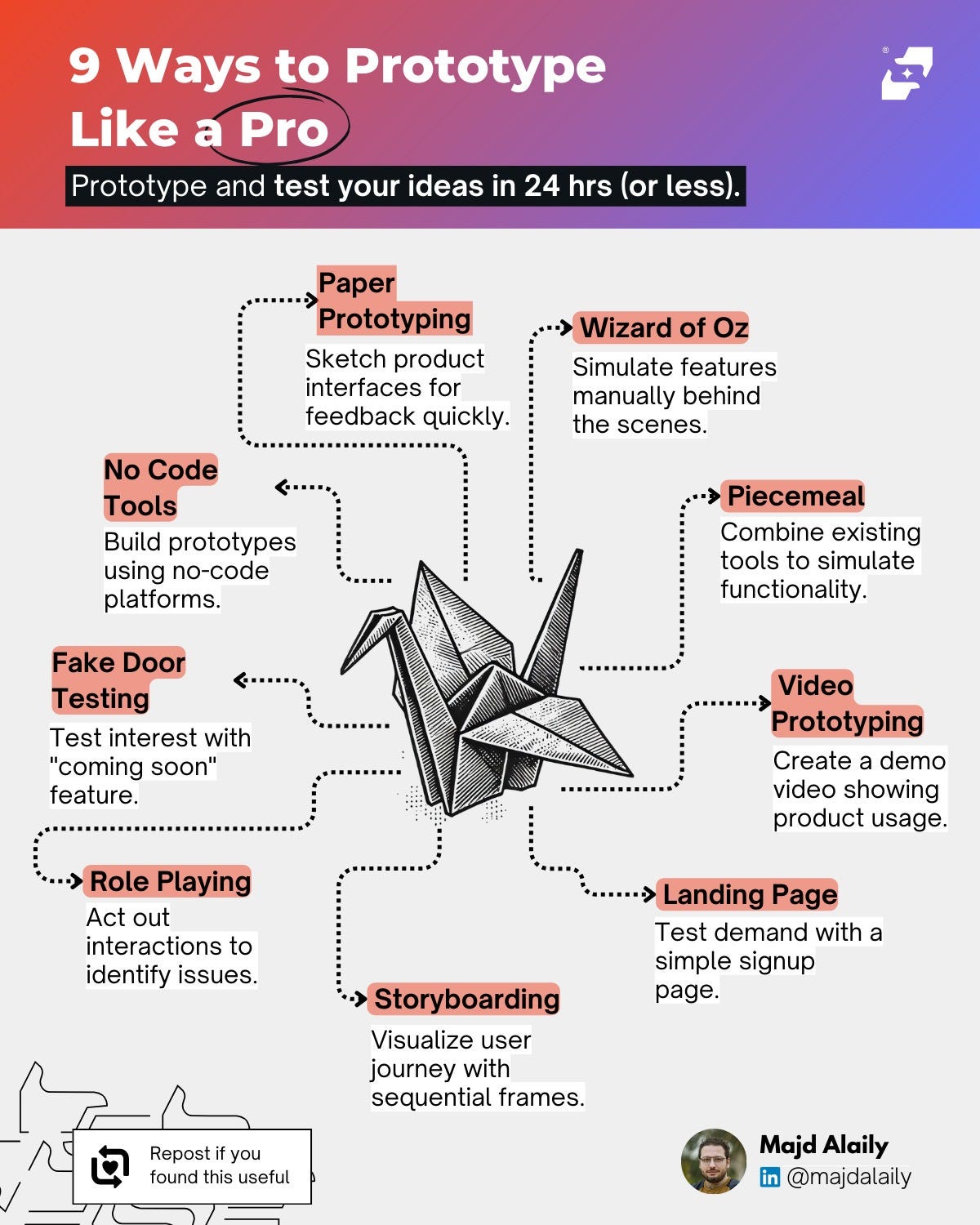
RUN THROUGH
1. Paper Prototyping
Paper prototyping is exactly what it sounds like.
You sketch the idea instead of building it, just enough to communicate the concept.
Fun ways to use it
Sketch a mobile app on sticky notes and let users rearrange screens.
Draw packaging concepts for a physical product and ask which one they would pick first.
Sketch a service flow on one page and ask users to narrate how they think it works.
How to do it, step by step
Grab paper, a pen, and 30 minutes.
Sketch the core screens, steps, or components. Keep it ugly.
Show it to 5 to 10 target users.
Ask them to explain what they think it does. Don’t correct them.
Note confusion, excitement, and gaps.
Redraw once based on feedback, then stop.
2. Wizard of Oz Prototyping
You make the product look automated, but everything happens manually behind the scenes.
Fun ways to use it
An “AI” tool that is actually you replying manually.
A concierge-style service pretending to be an app.
A recommendation engine powered by spreadsheets and WhatsApp.
How to do it, step by step
Define the outcome the user expects.
Create a simple interface or form that promises that outcome.
Deliver the result manually, quietly.
Track usage, satisfaction, and repeat behavior.
Ask users what they thought was happening behind the scenes.
Only automate if demand is real.
3. Piecemeal Prototyping
You stitch together existing tools to fake a complete product.
Fun ways to use it
Zapier plus Google Sheets as a backend.
Typeform as an onboarding flow.
Notion as a product dashboard.
How to do it, step by step
Break your product into components.
Match each component to an existing tool.
Connect them loosely. It doesn’t have to be elegant.
Give it to users and watch how they move through it.
Identify friction and unused parts.
Decide what is actually worth building later.
4. Video Prototyping
You show the product instead of building it. A short demo video does the talking, you see instant reactions without committing to development.
Fun ways to use it
A fake screen recording of a product that doesn’t exist.
A narrated walkthrough of a future service.
A simple slideshow pretending to be a live product.
How to do it, step by step
Write a one-minute script explaining the value.
Create mock screens in Figma, Canva, or Slides.
Record your screen while narrating.
Share the video with target users.
Ask what excited them and what felt unclear.
Measure interest, not compliments.
5. Landing Page Testing
A single page that tests demand before anything is built. Clicks and signups are more honest than opinions.
How to do it, step by step
Write a clear value proposition.
Build a simple page with one call to action.
Drive traffic through posts, ads, or outreach.
Track clicks, signups, and drop-offs.
Interview people who converted.
Kill or double down based on data.
6. Storyboarding
You map the user journey step by step, visually. It reveals gaps, assumptions, and broken flows before anything is built.
Fun ways to use it
Drawing a day-in-the-life of your customer.
Mapping emotional highs and lows.
Comparing the current experience vs your proposed one.
How to do it, step by step
Define the starting point and desired outcome.
Draw each step as a simple frame.
Share the storyboard with users.
Ask where they feel confused or skeptical.
Identify missing steps or false assumptions.
Refine the story, not the visuals.
7. Role Playing
You act as the product or service and walk through real scenarios. It surfaces edge cases and awkward moments fast.
Fun ways to use it
Pretending to be customer support for a product that doesn’t exist.
Running mock sales calls.
Simulating onboarding conversations.
How to do it, step by step
Define a realistic user scenario.
Assign roles, user and product.
Act it out end to end.
Pause when something feels clunky.
Adjust the flow and repeat.
Capture insights immediately.
8. Fake Door Testing
You test interest in a feature or product by offering it before it exists.
Fun ways to use it
A “Coming Soon” button.
A sold-out product page.
A feature toggle that does nothing.
How to do it, step by step
Add a button or link for the idea.
Track how many people click it.
Show a message explaining it’s not live yet.
Offer a waitlist or follow-up.
Measure interest relative to other features.
Decide if it’s worth pursuing.
9. No-Code MVPs
A functional but scrappy product built without traditional coding. You get real usage data without heavy investment.
Fun ways to use it
A marketplace built on Airtable.
A SaaS tool on Bolt or Lovable.
An internal tool on Replit.
How to do it, step by step
Strip the product to its core use case.
Choose the fastest no-code tool.
Build only what’s essential.
Launch to a small group.
Watch behavior closely.
Iterate before scaling or hiring engineers.
With that clarity, your ideas will start pouring out.
What if we sketched the product on paper and showed it to potential customers, then shut up and watched where they got confused?
What if we created a simple landing page with a preorder button and tracked clicks?
What if we filmed a short video showing how the product would be used and shared it privately?
What if we acted out the service manually behind the scenes and observed reactions?
What if we listed a product that didn’t exist yet and marked it as sold out?
None of these required code.
None required months.
Most could be done in hours.
When you remove the option to build, your brain is forced to think differently. You stop asking how do I make this, and start asking how do I learn the fastest.
Steal My Top 25 Founder Infographics
I spent the last 2 years building the definitive strategic blueprints that have helped 150+ founders validate faster, pitch better, and grow smarter.
These are the same battle-tested graphics and frameworks I use in my paid programs, but today, I’m giving away my Top 25 Founder Infographics, completely free.
Step 3: Look at each prototype and ask two simple questions.
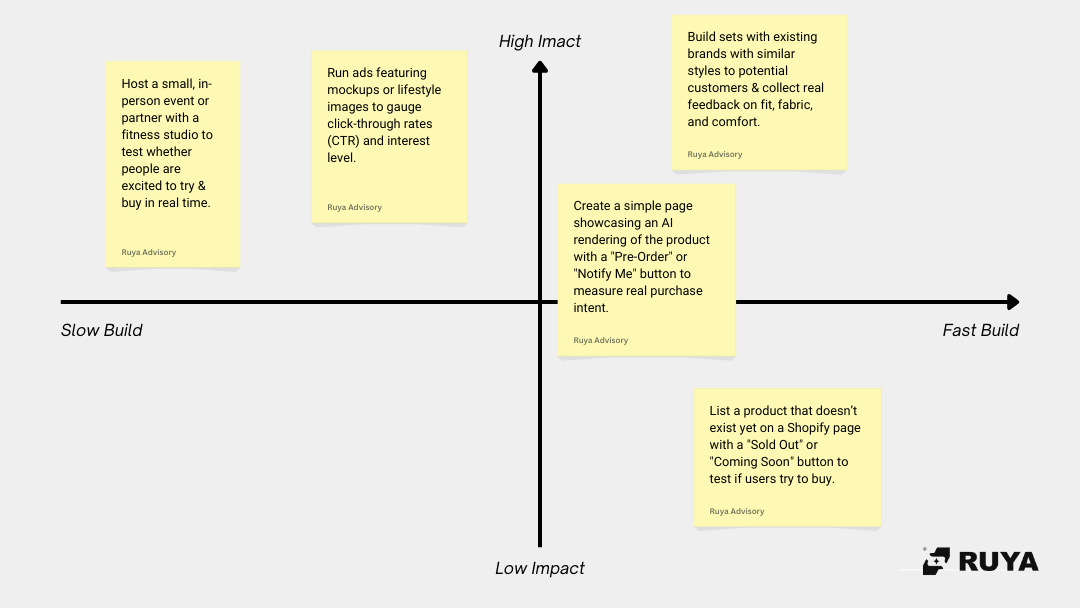
(1) How much does this help us validate our biggest assumption?
(2) How fast can we do it (1hr to 1 day max)?
The sweet spot is boring and powerful: High impact. Easy to execute.
Those are the prototypes worth running.
To move forward:
Pick one to three prototypes.
Build these in a day
Recruit 5 users
Test your prototypes this week.
Make sure to talk to real users. Watch what they do, not what they say. Adjust.
Imagine running this loop ten times in a month.
You don’t end up with a vague idea and a half-built product.
You end up with clarity, knowing what resonates, what doesn’t, what people are willing to pay for, and what people … don’t care about.
All before you commit serious time or money.
That’s the real advantage of rapid prototyping, speed and learning.
If you’re a founder reading this and you feel stuck because you’re not “ready to build”, that might be your signal.
You’re probably ready to test.
You just need to be honest about what you’re actually trying to learn.
And give yourself permission to fake it before you make it.
Before I go, I’ll leave you with a simple challenge.
This week, don’t ask yourself what should I build.
Ask yourself what do I need to prove.
Then design the fastest possible way to prove it.
See you on the edge,
Majd
More?
Hi, I’m Majd. I help early-stage founders with:
Daily Insights: Follow me on LinkedIn and Substack for startup strategies, tips, and real-world tactics.
Free Report: Try the Problem-Solution Pulse: get an 11-page personalized breakdown of your startup’s foundation.
Advisory Support:Explore Ruya Advisory to see how we can work together 1:1 or through founder programs.